
Apis mellifera carnica
The grey bee.
There are a handful of honey bee subspecies a beekeeper can choose from. We have only ever kept one.
Where it comes from
The Carniolan is native to Slovenia and the lands around it — parts of Austria, northern Italy, Hungary, Romania, Croatia, Serbia, Bosnia and Montenegro. Carniola itself is the historic region that gives the bee its name, and it sits at the heart of modern Slovenia.
It is not a fashionable import. It is the bee that evolved in the alpine-to-Mediterranean squeeze of that region: long winters at altitude, a short violent spring, and forage that can vanish for weeks. Everything distinctive about how it behaves follows from that.
What makes it different
- It is famously gentle
- Carniolans can usually be worked calmly, often with minimal smoke. This is the trait beekeepers mention first, and it is the reason the subspecies spread far beyond its homeland.
- It winters on very little
- The colony contracts to a small cluster and eats sparingly through the cold months. A hive that survives an Illinois winter without being fed heavily is doing something most bees cannot.
- It explodes in spring
- Population builds abruptly as the first real forage arrives, often peaking around May. The colony matches the bloom instead of guessing at it — which is exactly what you want in a climate where spring arrives when it feels like it.
- It reads a season honestly
- When forage stops, brood rearing slows. The colony does not keep spending into a dearth. The flip side is a strong swarming instinct when the hive runs out of room, which is the beekeeper's problem to manage, not the bee's fault.
- It keeps a clean house
- Well-developed hygienic behaviour — the habit of detecting and removing diseased brood — leaves Carniolans less troubled by some of the problems that plague other stock.
- It forages widely, including honeydew
- Carniolans find honeydew flows readily and work conifer forage well. In Slovenia that produces the dark forest honeys the region is known for.
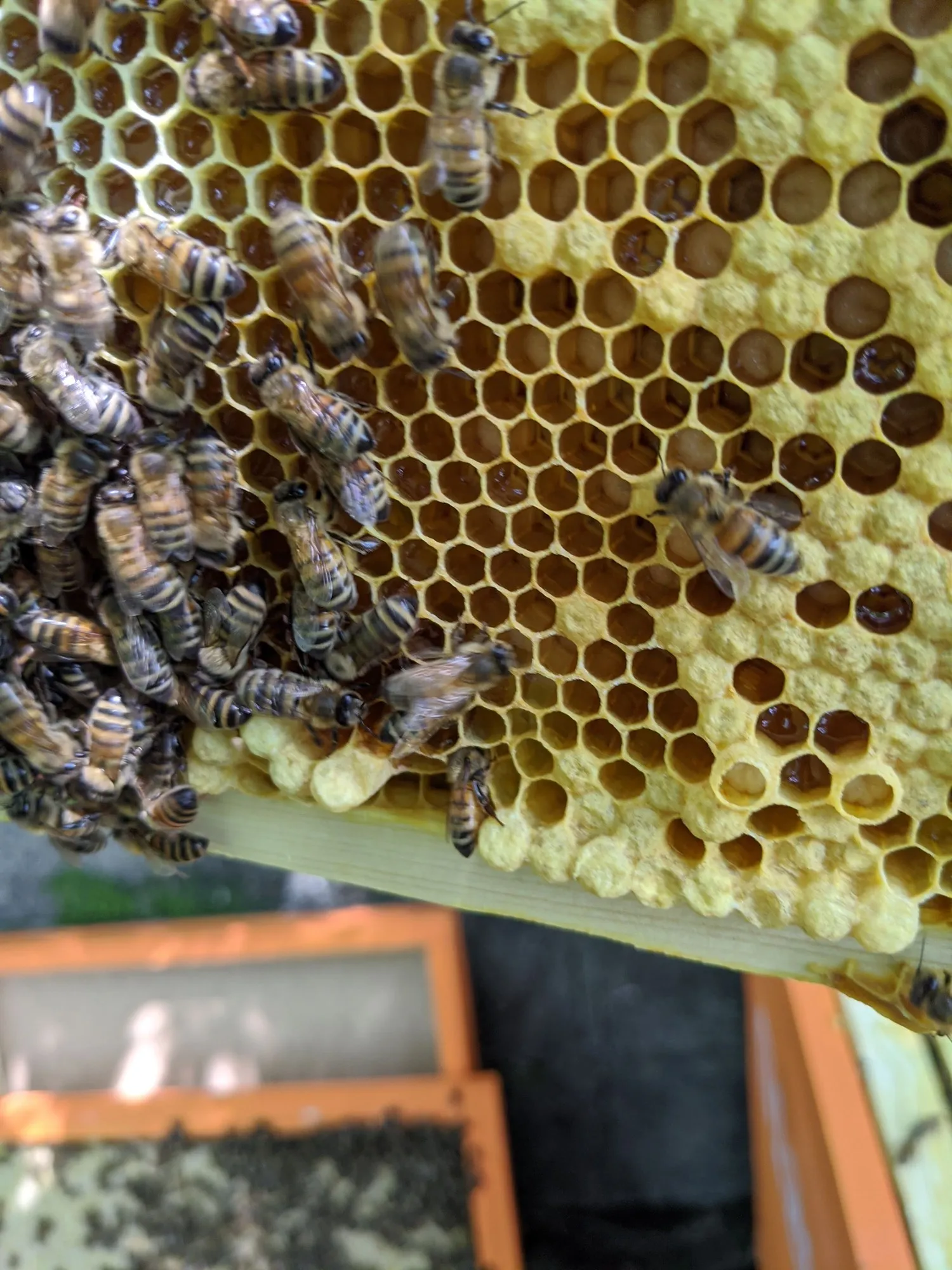
The nickname comes from the colouring: grey bands along the edges of the abdomen, where an Italian bee shows yellow.
Protected at home, exported everywhere
The Carniolan's reputation travelled early. Between 1857 and the First World War, something on the order of 170,000 swarms were shipped out of Carniola by documented count — with estimates running as high as half a million. Slovenia still exports roughly 40,000 queens a year.
At home the subspecies is protected: Slovenian beekeepers keep Carniolans and only Carniolans, so the native genetics stay intact rather than being diluted by imported stock.
Why we keep them
Everything above is true, and none of it is why we started.
We are Slovenian. Keeping the Slovenian bee is a way of keeping something else — a small, working piece of a culture that a family carries across an ocean and then has to decide, in every generation, whether to keep.
Slovenia protects this bee by law because it understands the same thing: that a place is partly made of what lives in it, and that letting the native bee thin out would be a loss you could not undo. No such law applies to us here. Keeping only Carniolans is a choice, and it gets made again every time we buy a queen.
That it also happens to be well matched to Illinois is a convenience, not a justification. Winters here are long and genuinely cold, spring is abrupt and unreliable, and summer can turn to dearth without much warning — which is close enough to the conditions this bee was shaped by that it thrives. And it is a pleasure to work, which counts for something when every yard is opened by hand.
Sources
Facts on the subspecies, export figures and Slovenian practice are drawn from the Slovenian Beekeepers' Association (Čebelarska zveza Slovenije). The judgements about keeping them in Illinois are our own.